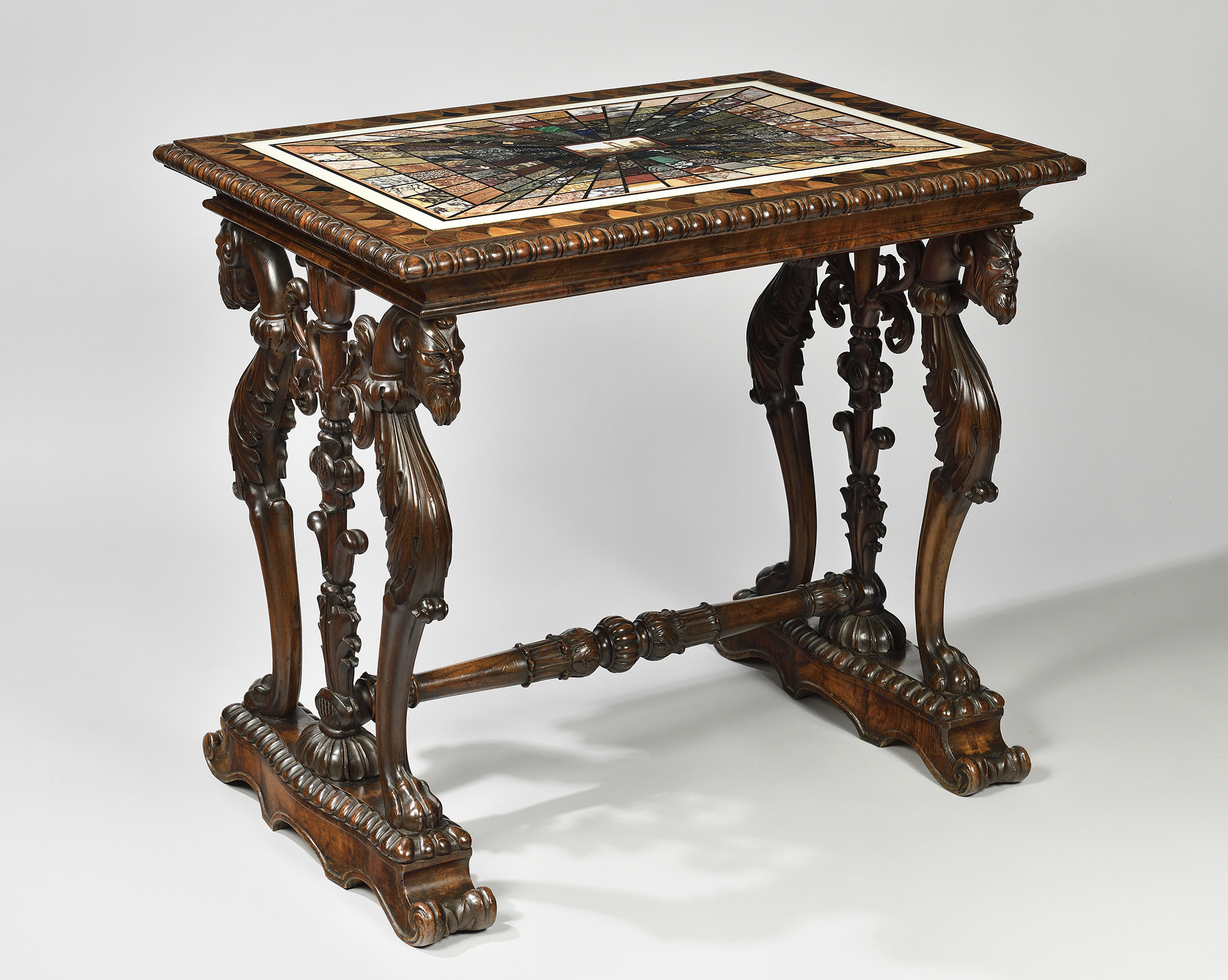
Italian table attributed to the cabinetmaker Henry Thomas Peters (Windsor 1792–Genoa 1852)
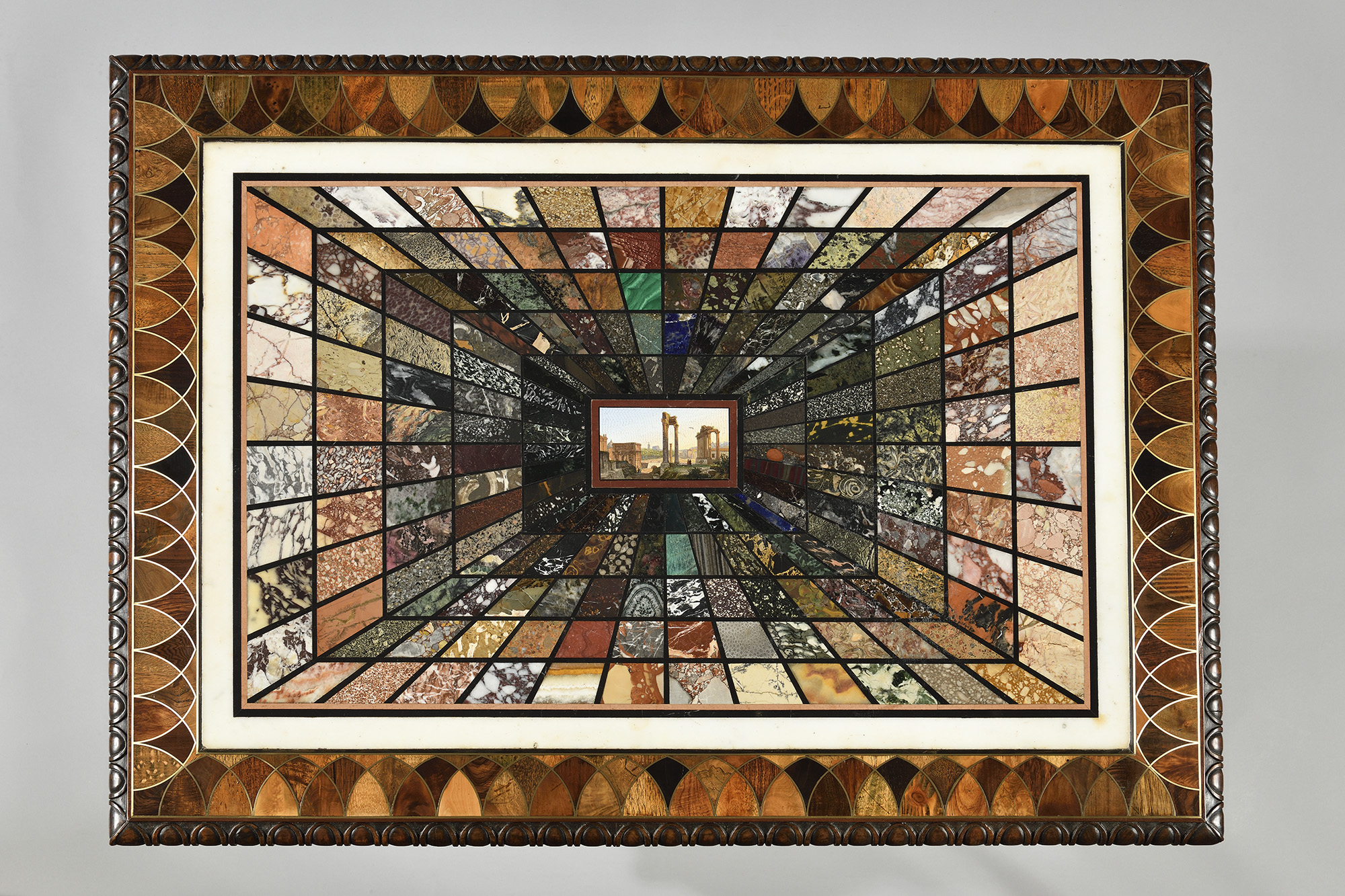
Rectangular top made of marble marquetry, forming a pattern with a chromatic perspective effect and centered on a micro-mosaic depicting a view of the Roman Forum.
A marquetry border made of various types of wood, edged with brass.
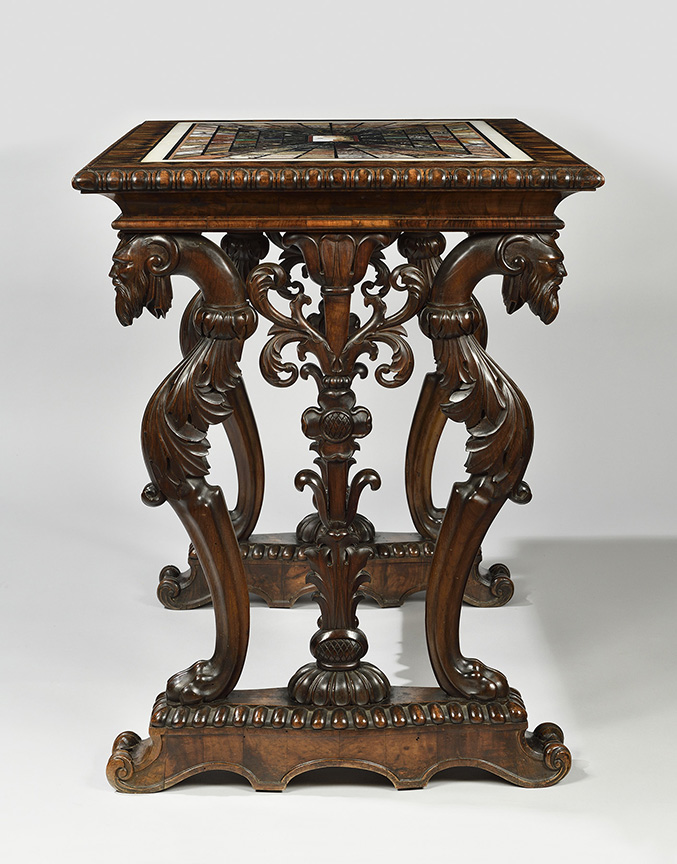
On a richly carved Neo-Renaissance-style base made of mahogany and mahogany veneer.
Genoa, circa 1830–1840
H 76 cm L 85 cm P 61 cm
The English origins of Henry Thomas Peters remain unclear, although he probably began his career in England. Having arrived in Genoa around 1817, he set up a studio in Via Balbi as early as 1824, a neighbourhood home to the Royal Palace and other noble residences. Today, some of his works are housed in the Palazzo Rosso in Genoa and probably originate from bequests by various aristocratic families for whom he worked, notably the Brignole Sale family. He initially specialised in Regency-style mahogany, but by around 1821–25, he was also producing gilded Empire-style furniture. His success enabled him to open a shop at the Palazzo Cambiaso and then, as mentioned in the Gazzetta of 14 February 1835, to move to the first floor of the Palazzo De Mari.
Between 1836 and 1846, he supplied furniture to the Royal House of Savoy for their palaces in Turin, Genoa and Racconigi, notably the furniture at the Palazzo Reale, and in particular, in 1841, the furniture for the wedding of Prince Victor Emmanuel II.
In 1846, Peters and his large workshop were awarded the silver medal at the Exposition dei Prodotti e delle Manifatture Nazionali.
This table is entirely typical of his work and bears witness to the collaboration with and influence of the architect Pelagio Pelagi (1775–1860). Pelagi’s modern taste and the circle of craftsmen and artists he led did indeed have a strong influence on Peters, notably by helping him to move away from the English style that had characterised him at the start of his career, thereby enabling him to explore new avenues.
The carved decoration on the base is indeed reminiscent of many of Pelagi’s designs and drawings, particularly the plant stems at the centre of the legs. However, this table stands out for its exquisite marble marquetry on the top, which is almost certainly a Roman piece from the same period. The chromatic perspective effect is entirely original and perfectly showcases the central micro-mosaic.

