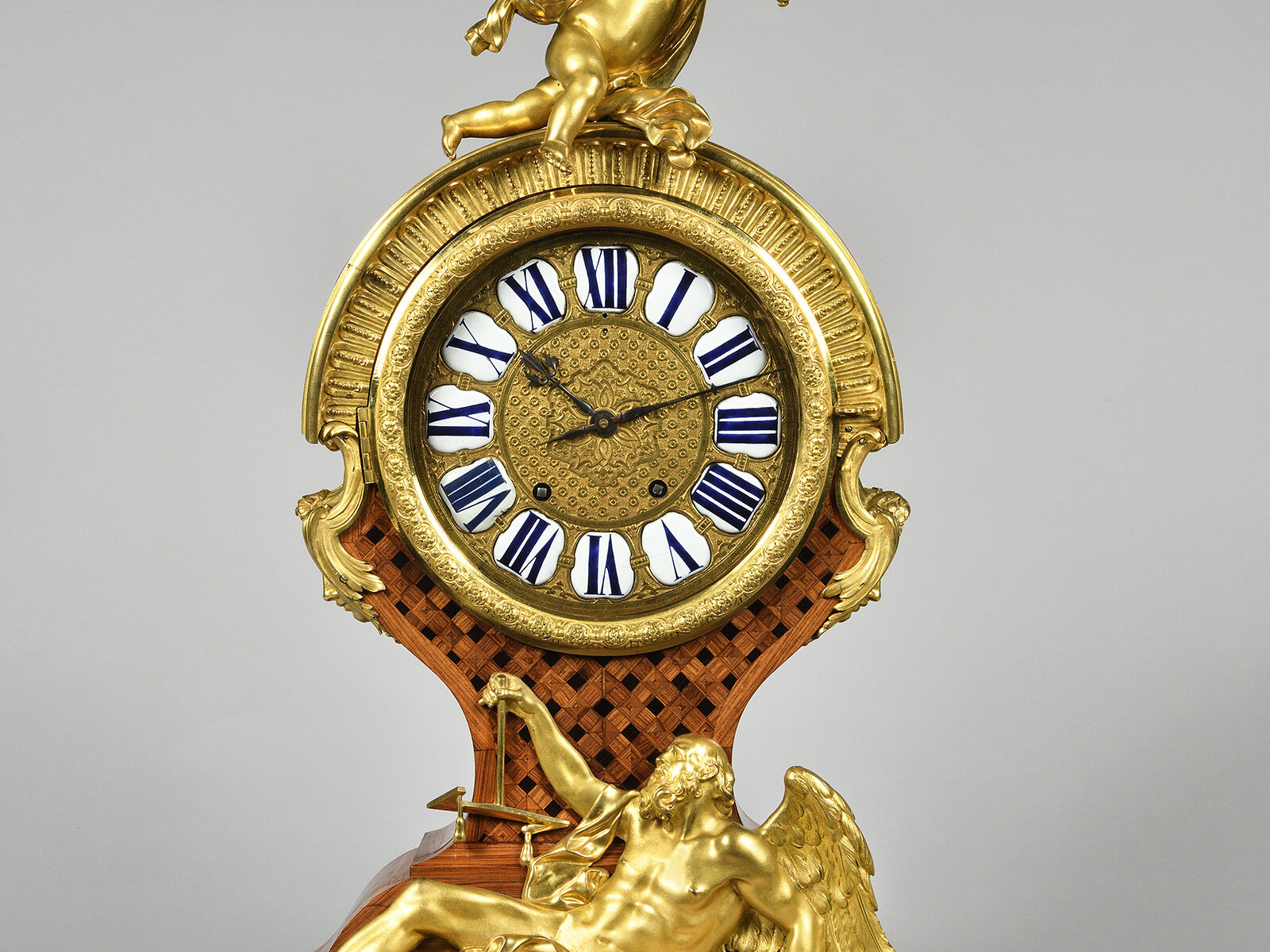
“Love Triumphant over Time” - Cartel attributed to André-Charles Boulle (1642-1732), who became a master craftsman before 1666.

Cartel attributed to André-Charles Boulle (1642-1732), who became a master craftsman before 1666.

The circular dial in finely chiselled bronze displays the hours in Roman numerals on twelve enamelled iron cartouches, with polished steel hands. 

The minutes are engraved in Arabic numerals on the border.

The movement is signed on the dial and on the back plate by Denis CHAMPION in Paris (1643–1706), who was the clockmaker to the Duke and Duchess of Orléans.

Chimes every half hour and hour. Escapement changed in England. 

Violet wood and ebony veneer marquetry, richly decorated with chiselled and gilded bronze.

Dimensions : H 79 cm L 54 cm P 23 cm

The ‘doll's head’ shaped case was designed very early on by André-Charles Boulle before 1700, as shown in the red chalk drawing kept at the Musée des Arts Décoratifs in Paris (Inv. 723 D6). Cupid is perched at the top of the dial, overlooking Saturn, the figure of Time, who is shown reclining on a projection of the case beneath the dial, clinging with his left hand and holding his attributes in front of him. The sides are decorated with a woman's head in espagnolette style, wearing a crown of flowers.  

Although there are several cartels of this model made by André-Charles Boulle, whose quality justifies their preservation in museum collections, only one other example made of wood marquetry like this one is known to exist. It belongs to the collections of Waddesdon Manor, near London, a residence created by the Rothschild family to house part of their exceptional collection. The death of clockmaker Denis Champion in 1706 places the creation of these wooden marquetry cartels at the very end of the 17th century or around 1700.
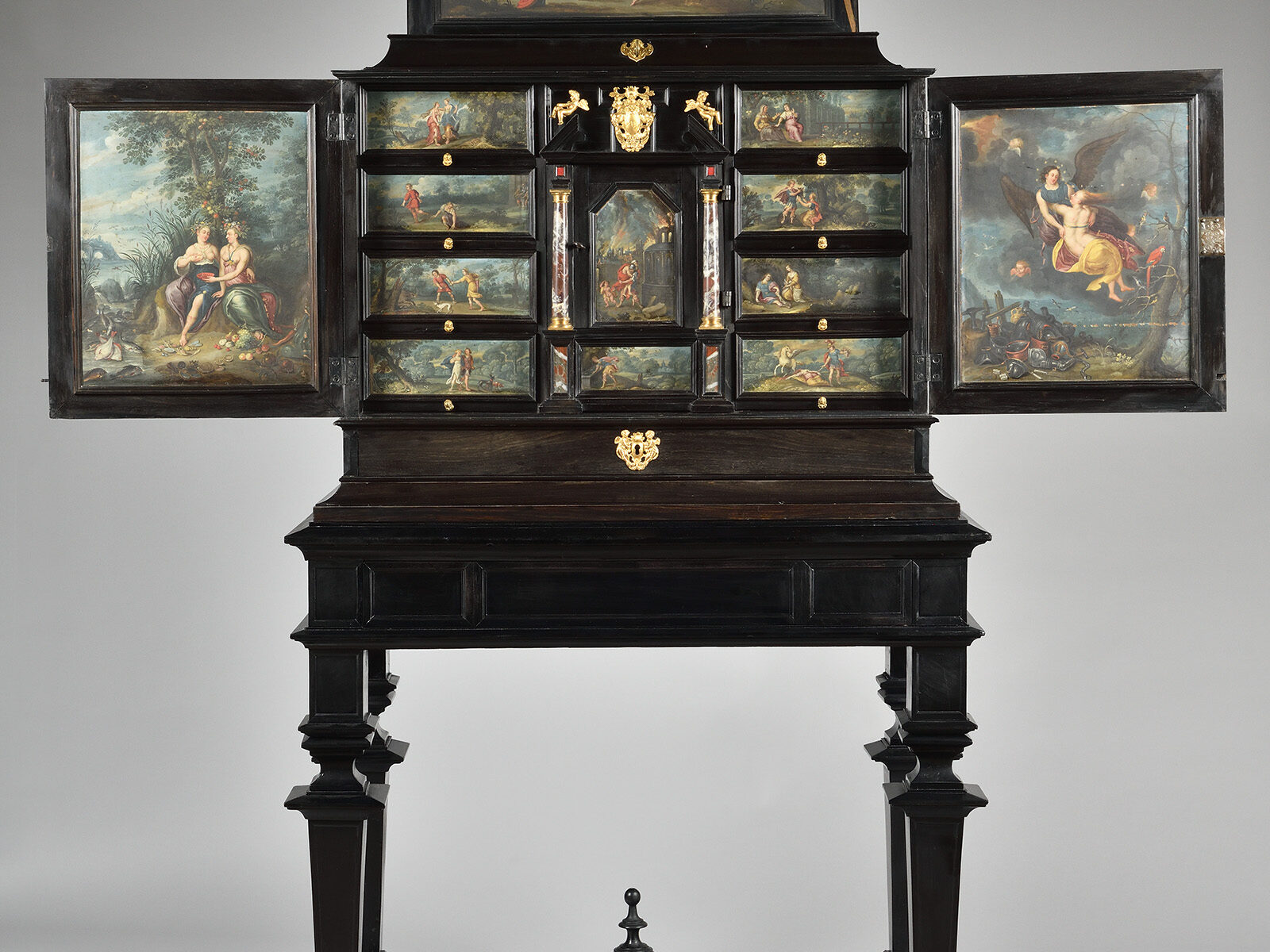
Rare Antwerp cabinet decorated with paintings attributed to Hendrick Van Balen (1575–1632) and Jan Brueghel the Elder, known as Brueghel of Velvet (1568–1625)

Rare Antwerp cabinet decorated with paintings attributed to Hendrick Van Balen (1575–1632) and Jan Brueghel the Elder, known as Brueghel of Velvet (1568–1625)

13 panels painted on copper decorating the drawers and doors with subjects taken from Ovid's Metamorphoses and representing the four elements

Ebony, marble, engraved mercury mirrors, and chiseled and gilded bronze ornamentation. 

Early 17th century, Circa 1620-1625

Modern blackened wood base

Dimensions : Cabinet H 68,5 cm W 88 cm D 39 cm.

With base H 157 cm W 95 cm D 43 cm

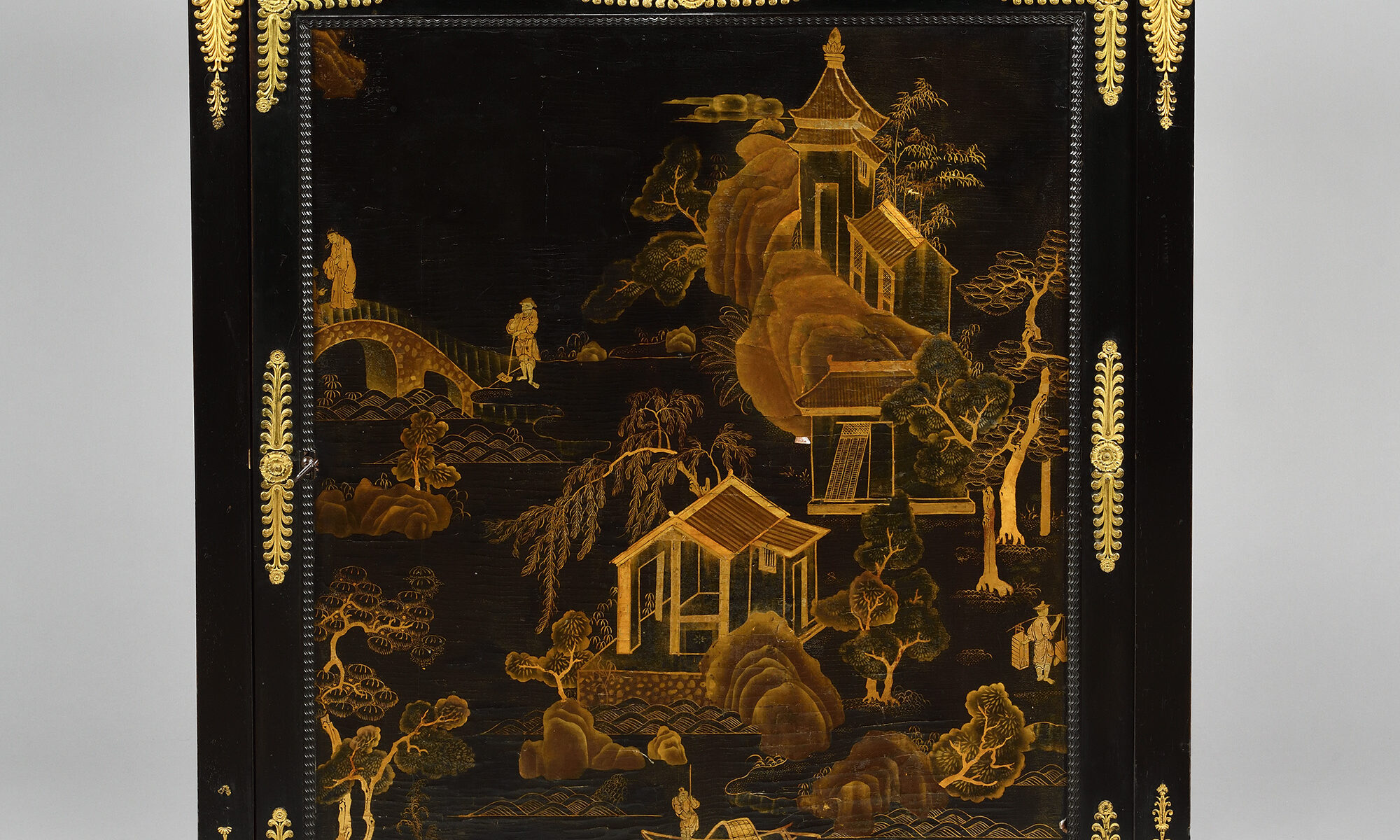
Restoration period meuble d'appui

Restoration period meuble d'appui

Ebony, Chinese lacquer, and vernis Martin. Gilded bronze ornamentation

The central and side panels are decorated with various figures, pagodas, trees, boats and a bridge in rural and mountainous landscapes, surrounded by undulating mouldings. The marble top rests on a guilloché moulding with a pearl motif, topped by a cornice alternating acanthus and lotus leaves, above a long frieze drawer composed of two panels decorated with repeating motifs of exotic birds, flowers and trees. The frieze drawer, lined with cedar, has a central lock concealed by a bust of a pharaoh, above a moulding with a beaded and scroll border. A large door below, gilt bronze ornamentation composed of palmettes centred on a rosette, enclosing a walnut-lined interior with two adjustable shelves. The whole stands on a wide plinth.

Circa 1820-1830

Provenance: Former collection of Comte and Comtesse de Viel Castel

H 117 cm L 91,5 cm P 48,5 cm

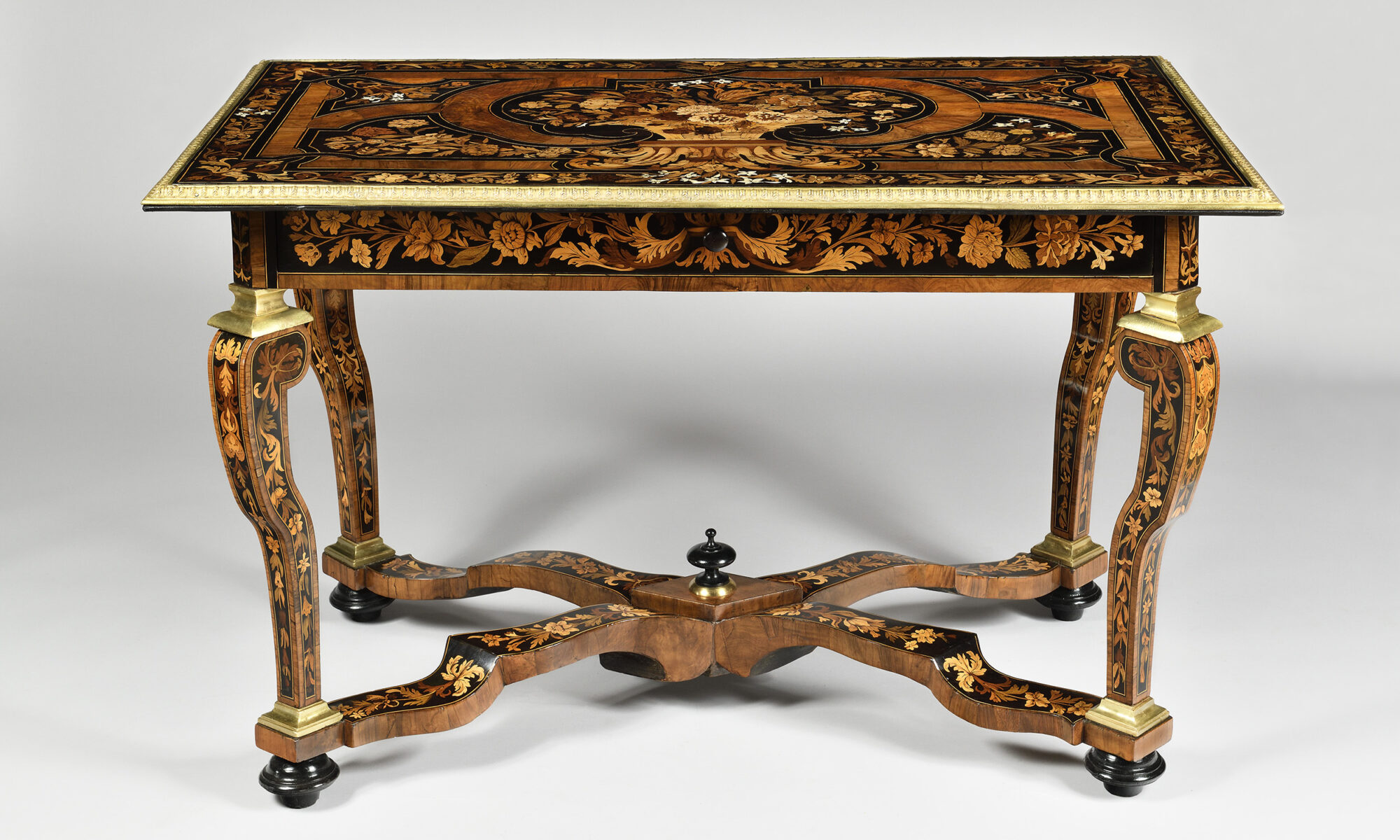
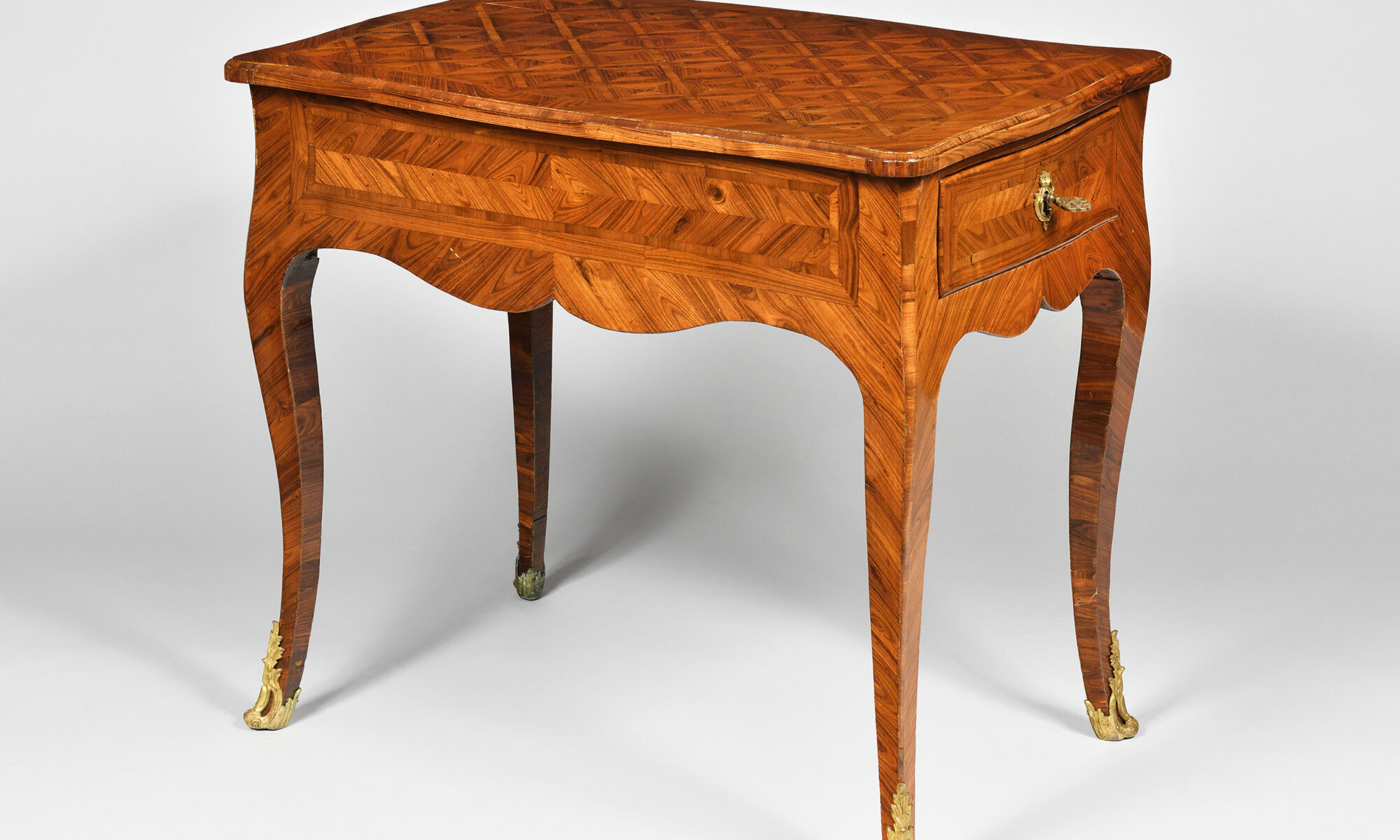
Table à écrire d’époque Louis XIV en marqueterie

Table à écrire d’époque Louis XIV en marqueterie

En marqueterie florale toutes faces de bois de rapport sur fond d’amarante et d’ébène, incrustations d’os. Le plateau orné en son centre d’un panier fleuri animé de fleurs de jasmin posé dur un entablement en feuilles d’acanthe d’où s’échappent des rinceaux fleuris, l’ensemble entouré d’une frise fleurie. Une lingotière ornée de motifs lancéolés protège l’ensemble. La ceinture en totalité couverte d’une marqueterie de fleurs ouvrant par un tiroir, reposant sur des pieds en volute sommés de chapiteau, réunis part une entretoise en X mouvementée sommée d’une toupie et terminés par des pieds également de forme toupie.

France or Holland, circa 1680–1690

H 75 cm L 118 cm P 69 cm

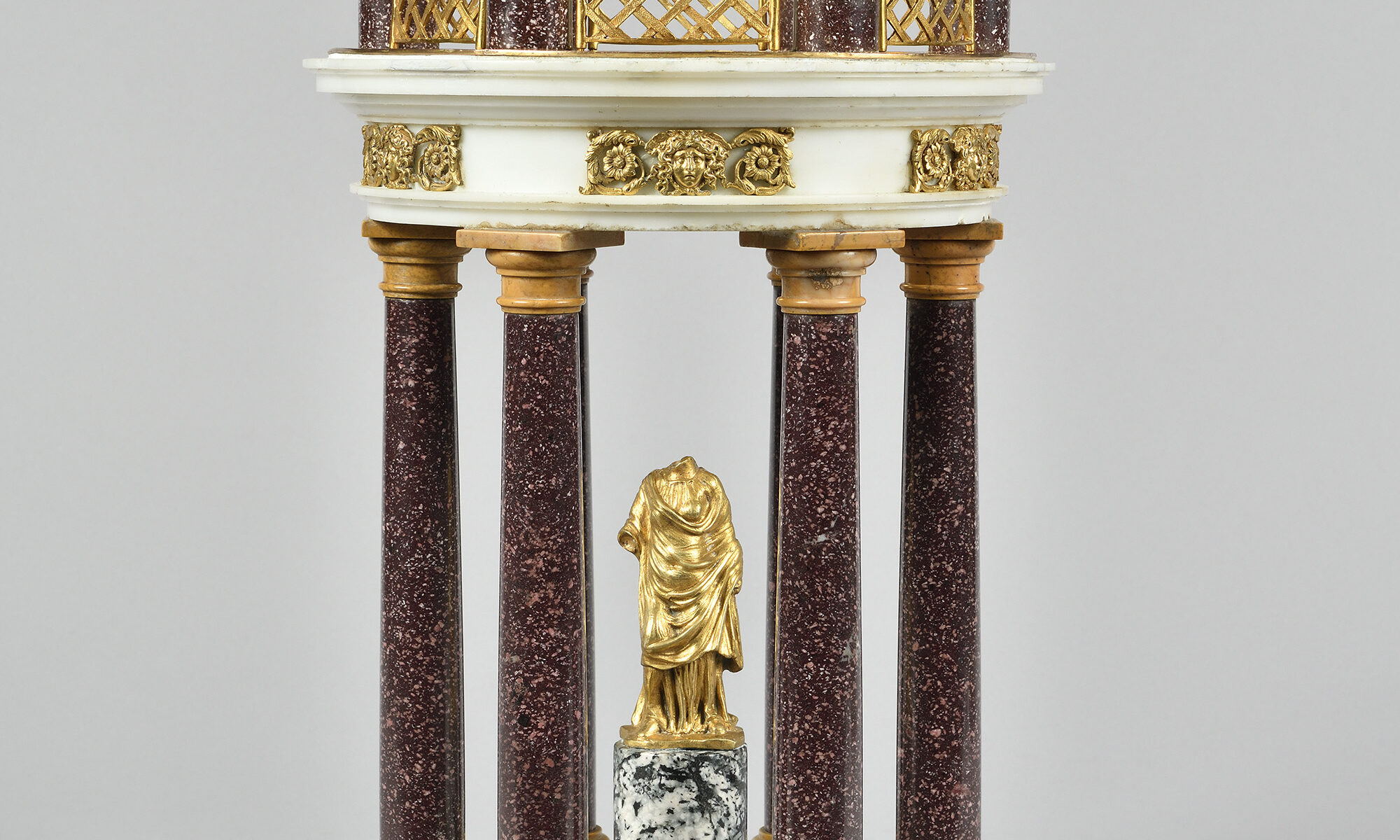
Centre de table attribué à l’atelier de Luigi et Giuseppe Valadier – Rome, Fin du XVIIIe -début du XIXe siècle

Marbre blanc, porphyre rouge, granito della colonna, rosso brecciato, brocatelle d’Espagne et vert de Vérone. Ornementation de bronze ciselé et doré.

In the form of a circular porphyry colonnade centred on an antique female sculpture in gilded bronze on a marble marquetry pavement. The entablature is decorated between each column with a gilded bronze motif of acanthus leaves surrounding a Gorgon mask. At the top of the balustrades alternate vases or pyramidions in gilded bronze on a porphyry base. The whole rests on ball-shaped pedestals.

Roma, Late 18th-early 19th century

H 43 cm D 30 cm

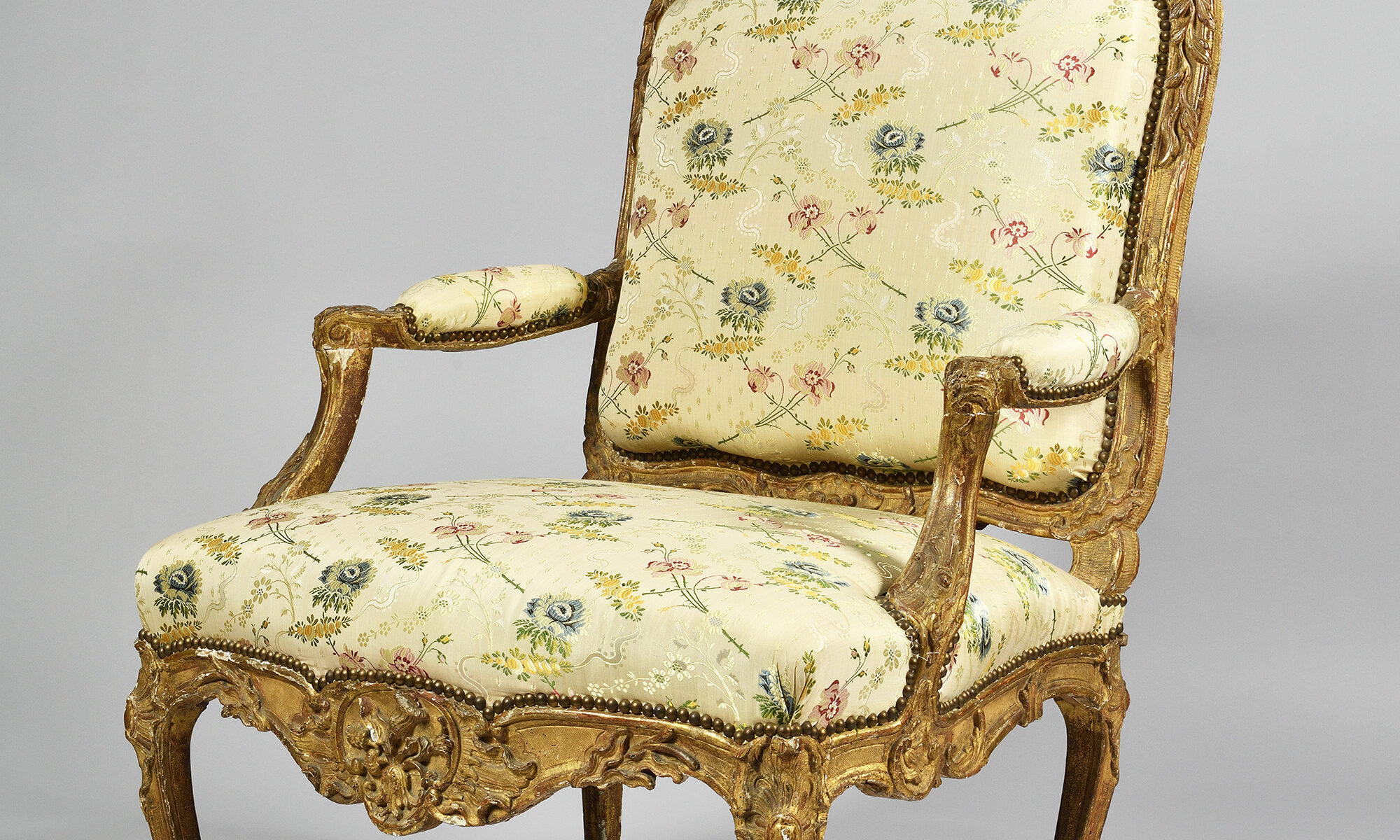
Large fauteuil à la reine d’époque Louis XV

Large fauteuil à la reine d’époque Louis XV

Carved and gilded wood.

Flat curved backrest. Carved with rocaille motifs, bursting pomegranates and large flowers. Armrests with cuffs. Curved legs with foliage motifs. Modern floral silk upholstery.

Circa 1740

H 109 cm L 81 cm P 78 cm

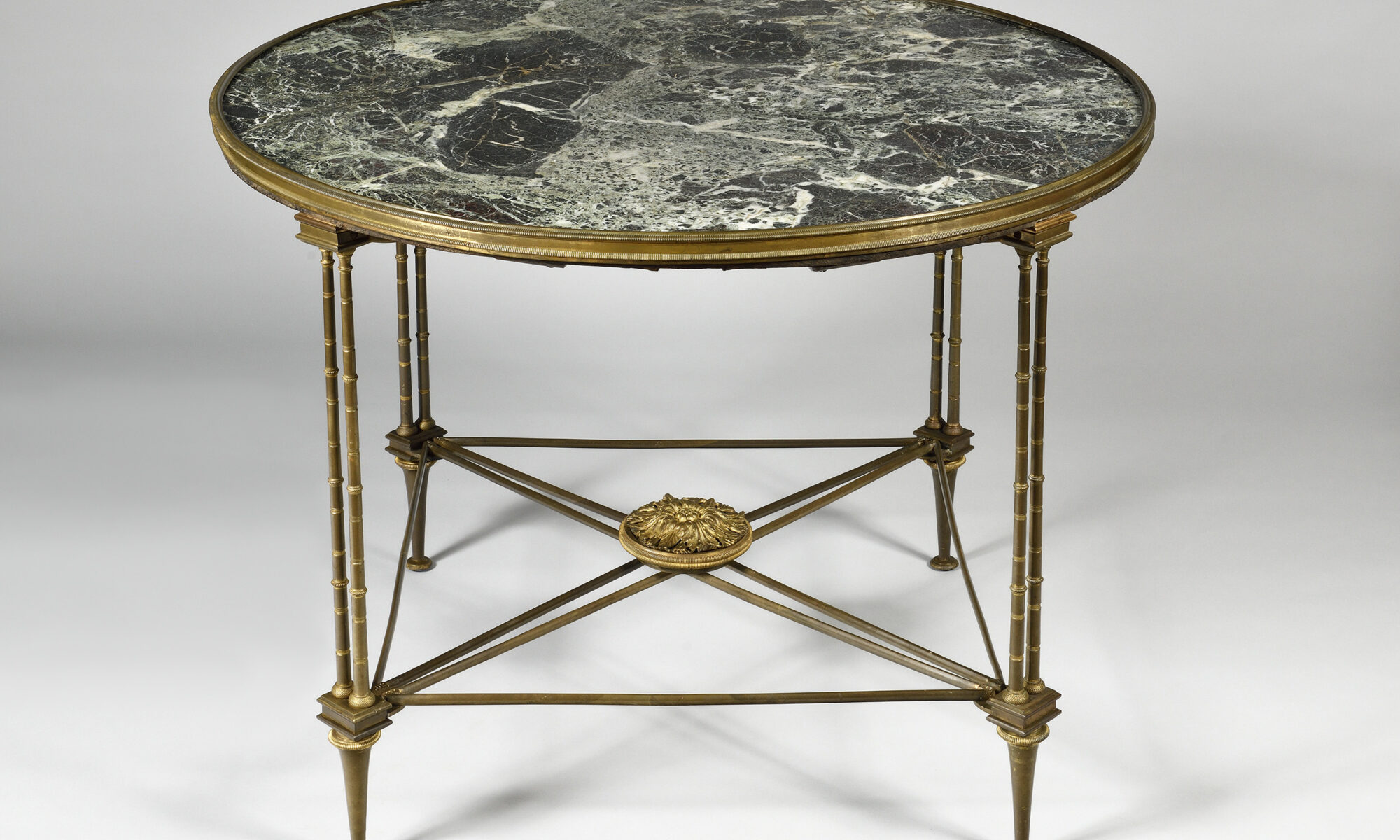
Grand guéridon d’époque Louis XVI

Grand guéridon d’époque Louis XVI dans le goût d »Adam Weisweiler (1744-1820)

Gilded bronze and green marble top

Large plateau de marbre vert ceint de bronze doré. L’ensemble supporté par des montant formés de quatre paires de colonnettes à l’imitation de tiges de bambou en bronze doré sur des pieds ronds fuselés et jointes par une entretoise en X jumelée à rosace centrale

Late 18th century

H 75 cm D 100 cm

en_GB