Important Louis XIII period cabinet
Made of oak, fir and walnut. Ebony and ebony veneer.
Rosewood and amaranth veneer. Mercury mirrors. Oil on panel
Original base
Paris, Circa 1635-1640
H 189 cm L 155 cm P 58 cm
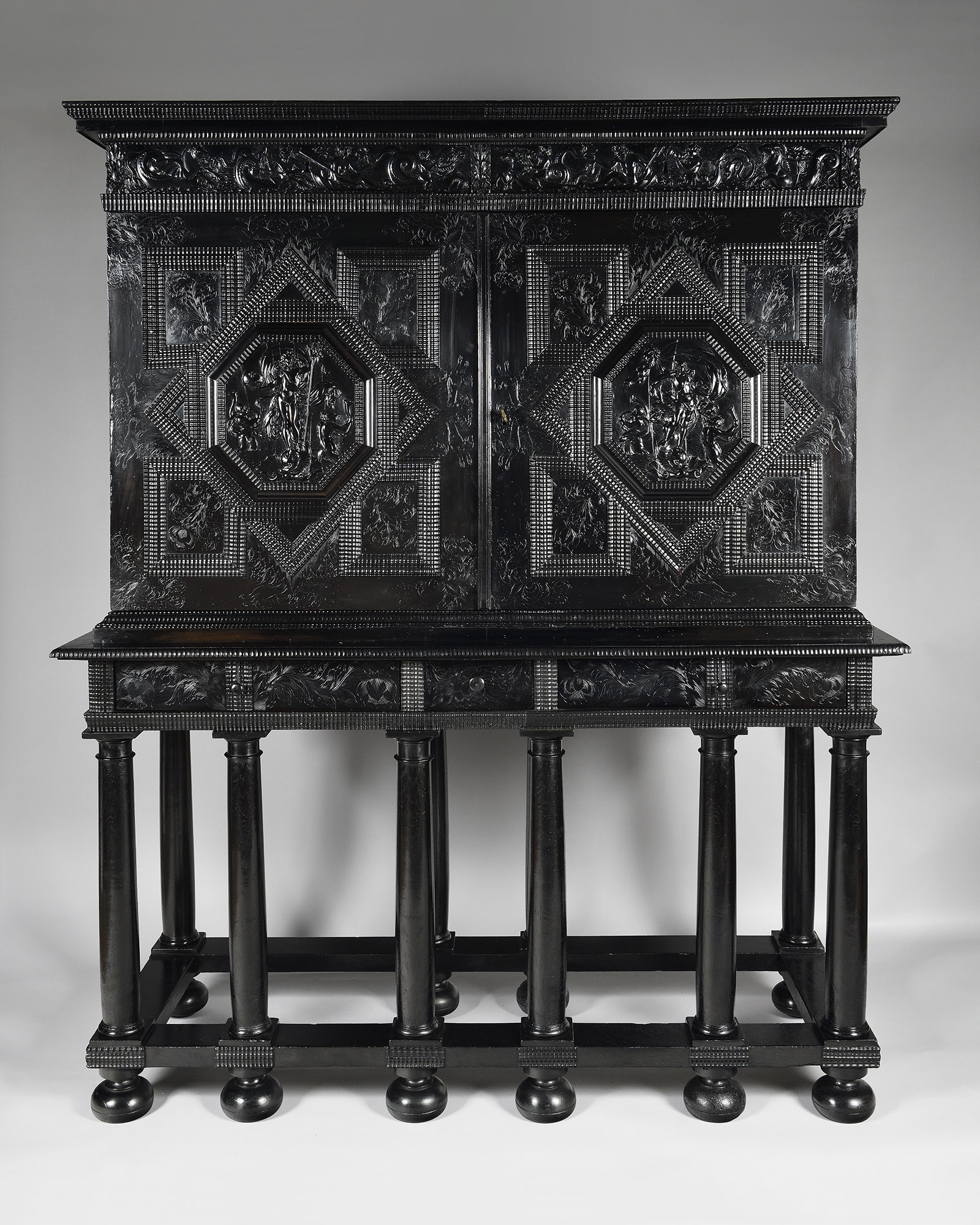
This large Louis XIII cabinet on its base is a thoroughly characteristic example of the work of Parisian cabinetmakers who were employing new techniques introduced from abroad by ‘ebony joiners’—mainly from Germany and the Netherlands—but also represents a particular phase in the history of furniture in terms of its form and function.
This piece of furniture consists of two distinct parts: an upper section forming a cabinet and a column-style base.
The upper section is crowned by a projecting moulded cornice, which surmounts a rectangular frieze carved in bas-relief. This frieze features a rich decoration depicting a procession of marine and mythological creatures, separated by a central motif. Among them are deities or sea nymphs, likely associated with the triumph of Amphitrite or Neptune, riding sea monsters, fantastical dolphins and tritons.
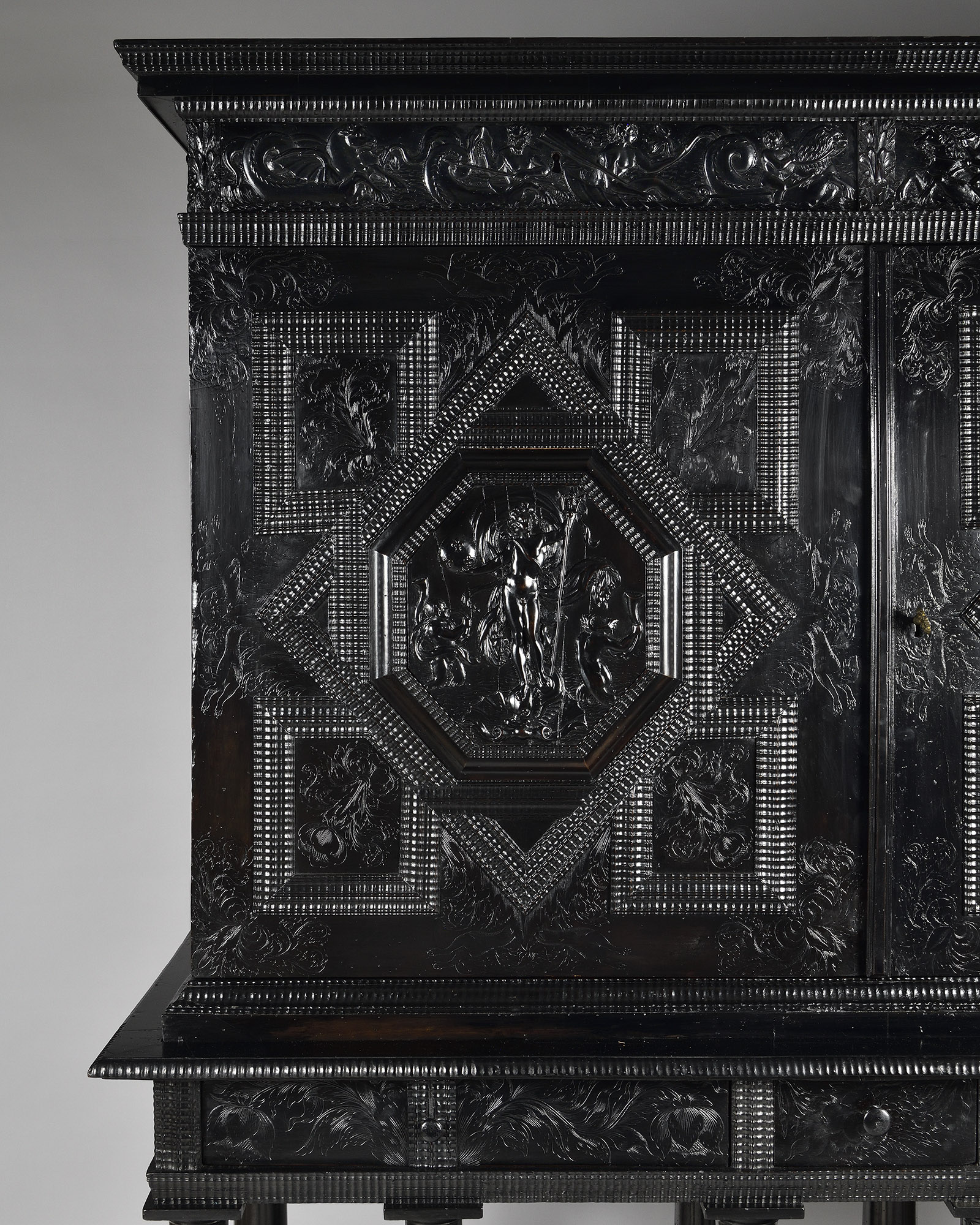
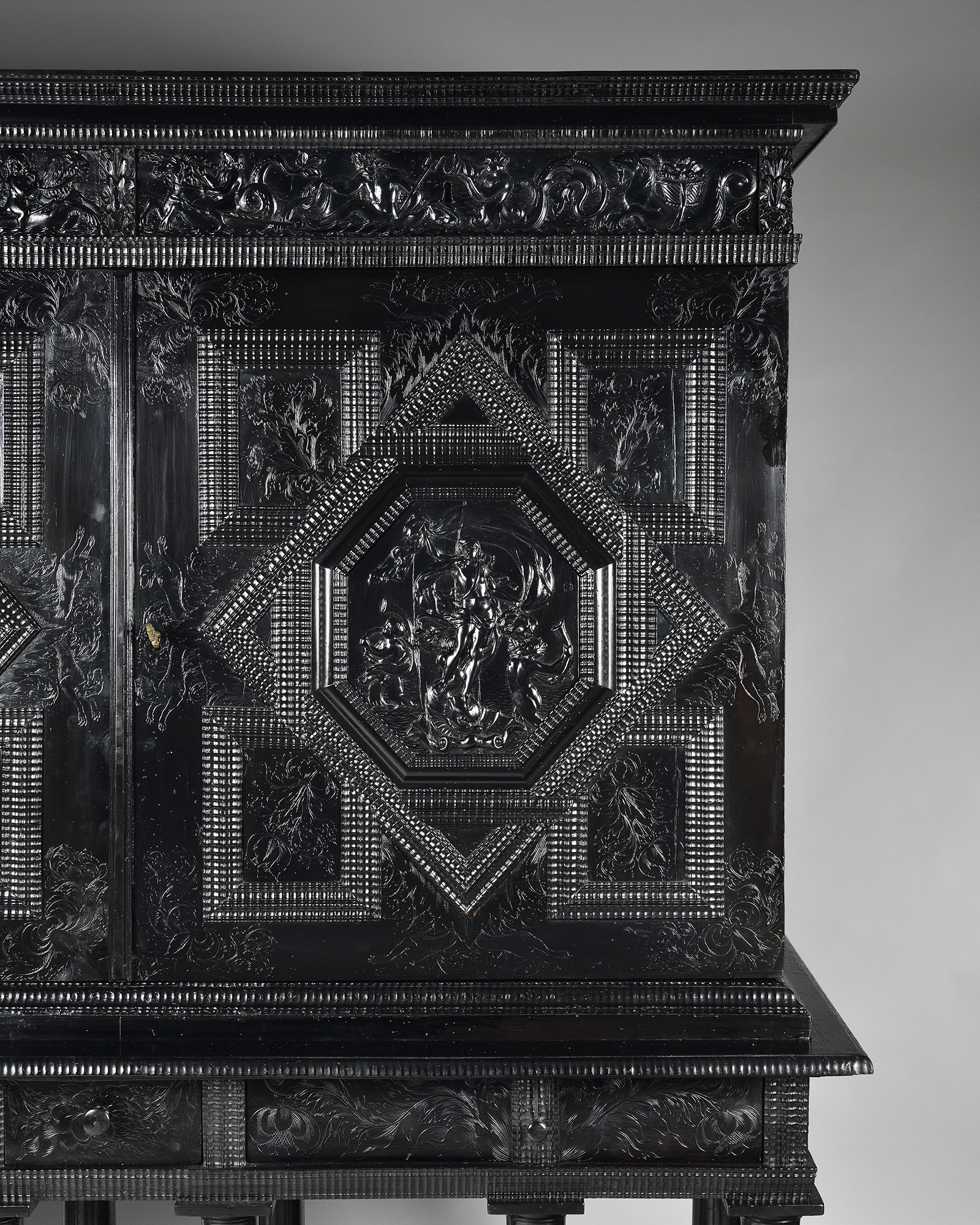
The façade is closed off by two large, richly carved door leaves. Each door features a large central octagonal panel framed by guilloché patterns or wavy mouldings.
At the centre of these octagons are intricate bas-reliefs carved in high relief, depicting mythological scenes. These depict the triumphs of Neptune and Amphitrite. On one side, Neptune, god of the sea, stands in the centre, depicted as a young man, firmly clutching his trident and a globe adorned with fleur-de-lis, commanding the waves alongside sea creatures. On the other side, Amphitrite, a Nereid and wife of Neptune, is depicted in a dynamic pose, surrounded by tritons.
The compositions, rendered with deep relief and meticulous modelling, form the focal point of the piece. The surrounding rectangular panels are adorned with carved acanthus leaves and scrollwork, whilst the backgrounds are covered with an engraved design of scrolls, leaves and plant motifs, playing on the contrasting sheen of the ebony.
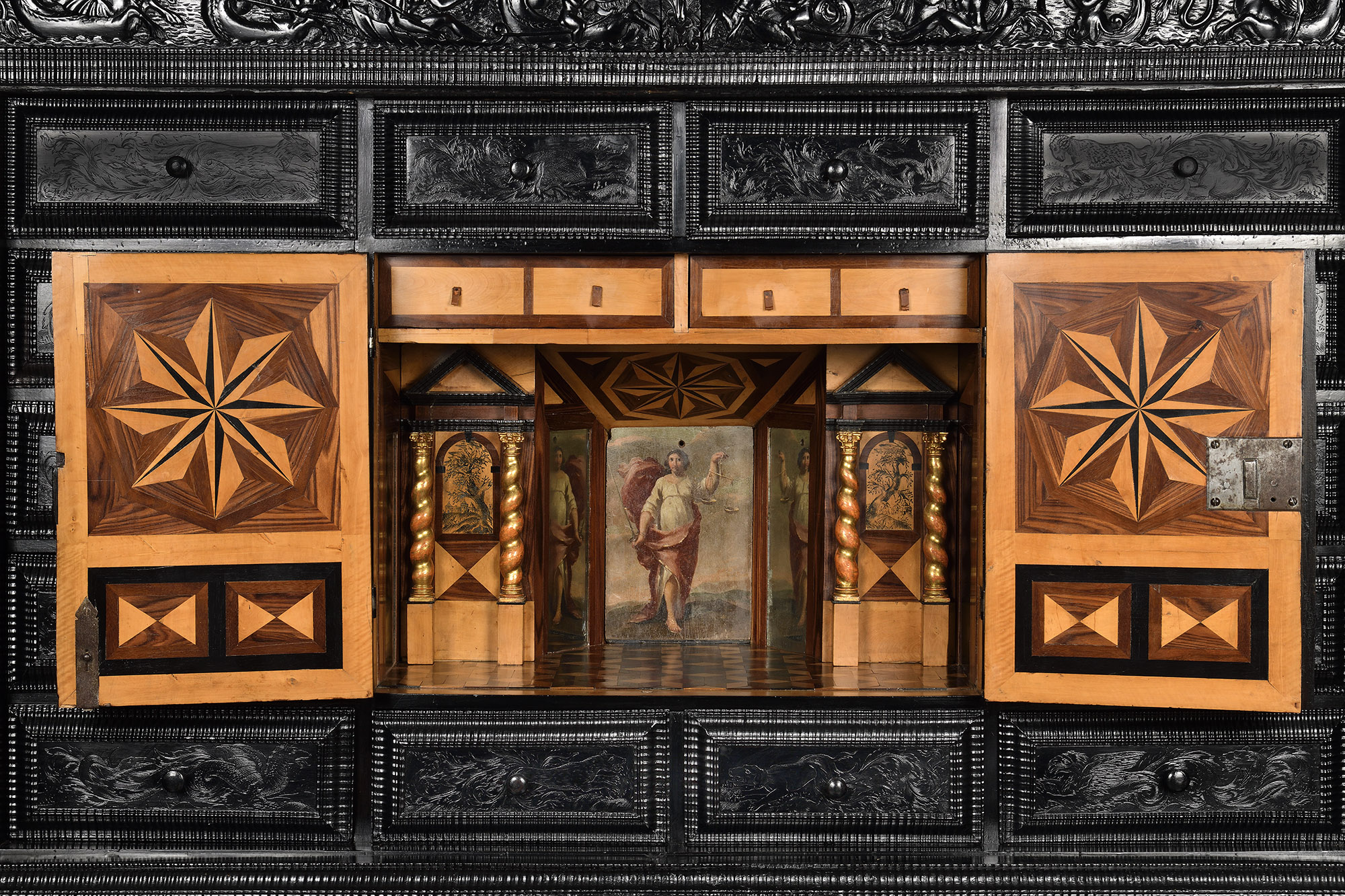
The interior reveals a richly decorated interior: twelve drawers, whose fronts are engraved with foliage and animals—such as leopards, dogs and chimeras—and framed by undulating mouldings; and, behind the two central doors, an architectural trompe-l’œil niche. It is flanked by gilded twisted columns and adorned with a chequerboard-patterned marquetry base. At the back, a painted panel depicts Justice with her scales and sword. Behind the two side panels lies a series of two sets of four secret drawers.
The inner panels feature marquetry in the form of a radiating star, made from walnut, light-coloured wood and ebony.
The cabinet rests on a plinth with an overhanging moulding, which houses a cabinet with drawers. The front of the cabinet, divided into sections by moulded uprights, is decorated with engraved foliage scrolls and fitted with turned pull-out knobs.
The original base comprises twelve columns – six at the front and six at the rear – with slightly curved shafts, moulded bases and capitals, resting on cuboid blocks with wavy decoration and linked by a frame-like crossbar. The whole structure rests on flattened ball feet.
This important cabinet, part of the select group of grand ebony cabinets, is the most iconic piece of French furniture from the first half of the 17th century. Examples of this type of ebony cabinet can be found, in particular, at the Musée du Château de Fontainebleau and the Louvre, the Metropolitan Museum of Art in New York, the Rijksmuseum in Amsterdam, Windsor Castle and the Museum of Fine Arts in San Francisco.
In the 17th century, these cabinets were highly prized by the French aristocracy. Cardinal Mazarin, in fact, had several ebony cabinets in his collection, most of which featured ivory decorations. Nicolas Fouquet, too, spent part of his fortune on these iconic pieces.
It was from the 16th century onwards that ebony began to be used in Europe for small items only, given the rarity of the wood and the difficulty in working with it.
Thanks to the Edict of Tolerance of Nantes, issued in 1598 by Henry IV, Flemish and German cabinetmakers of the Protestant faith settled in Paris. From the early 17th century onwards, they brought with them their expertise, as well as the technique of veneering, to the manufacture of French furniture, which until then had been made from solid wood. The use of ebony and the veneering technique gave rise to the term ‘cabinetmaker’ and marked a pivotal milestone in the decorative arts in France.
This iconic piece of furniture offers a striking contrast between the ebony veneer on the front, which lends it an austere appearance, and the interior, which is vibrant, colourful and dynamic. These interiors are skilfully composed of ivory marquetry, coloured wood, rosewood, bone, mirrors and paintings.
Originally used to store important documents and valuable objects, these cabinets remain primarily pieces of ceremonial furniture, particularly the larger ones. Indeed, smaller cabinets began to appear later on.
It is important to note that the relief carvings on the main panels of ebony cabinets are carved by cabinetmakers, drawing on decorative trends popular during their time.
Engravings are the main source of inspiration for decoration, but they are not the only one. Tapestries and bronze plaques also serve as sources of inspiration. Mythological and religious scenes predominate. The engravings come from a variety of sources, including French, Italian and Flemish prints. Among the most famous are, for example, Nicolas Chaperon, Michel Dorigny and Antonio Tempesta…
There is also a striking chronological proximity between the date of publication of the illustrations and the creation of the ebony panels based on those illustrations. Collectors of ebony cabinets were therefore keeping up with the latest literary and artistic trends. We know that cabinetmakers would modify the original compositions to adapt what were sometimes rectangular formats to a circular one.
The depictions of Neptune and Amphitrite are, of course, based on engraved models.
They can be compared to the prints produced from models by the painter Michel Dorigny (1616–1665).
Depictions of Amphitrite are rare in Greek art, but she became a much-loved figure in classical-style art from the 17th century onwards. This depiction of Amphitrite and Neptune on their sea chariot can also be found in prints by the Dutch engraver Hendrik Goltzius from the early 17th century.
This iconography of triumphant sea gods also features in *The Triumph of Neptune* by Nicolas Poussin (1594–1665), dated 1635–1636 and held at the Philadelphia Museum of Art.
The two large top drawers are carved with aquatic scenes depicting men battling sea monsters, sea horses and Nereids, who form Neptune’s retinue and echo the design on the two door panels.
This fantastical oceanic ornamentation is also clearly inspired by Michel Dorigny’s engravings.
This repertoire of aquatic imagery often symbolised mastery of the seas and prosperity.
Daniel Alcouffe, co-author of the book Un temps d’exubérance – Les Arts Décoratifs sous Louis XIII et Anne d’Autriche provides us with detailed information on the development of these ebony cabinets in the 17th century. The art historian identifies three phases in the creation of these cabinets:
– The first period dates from between 1630 and 1640 and is characterised by simple geometric shapes carved onto the exterior. He also points out that it was during this phase that painted decoration was most commonly used. This is referred to as a fusion of painting and cabinet-making.
– The second phase, dating from around 1640, is characterised by panels featuring interlacing wavy mouldings, with allegorical figures at the four corners of the panels.
– The third phase, dating from around 1645–1650, features more complex forms, notably architectural compositions on the façade.
We can therefore date this cabinet to the end of the first phase, and thus estimate that it was made around 1635–1640.

