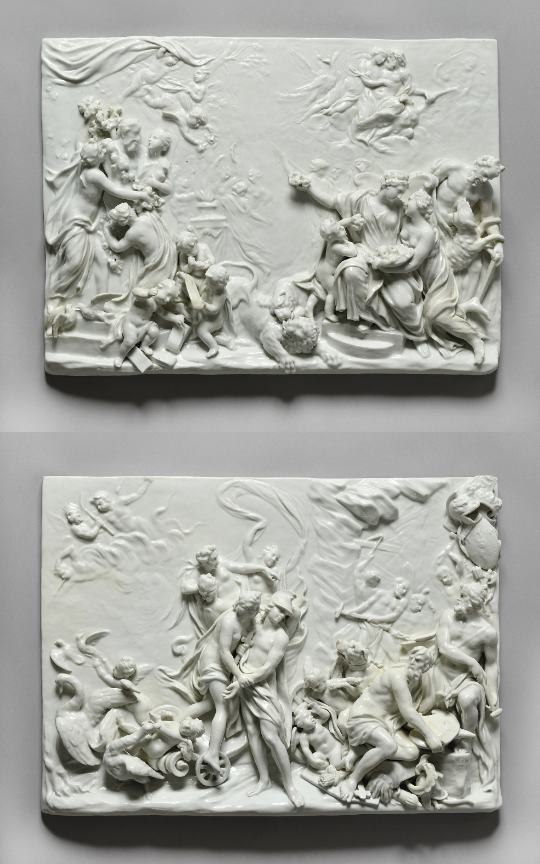
Two large porcelain high-reliefs depicting Spring and Winter – Doccia-Sesto Fiorentino Manufactory
Each is modelled on the originals depicting the Four Seasons by the Florentine bronze artist and sculptor Massimiliano Soldani Benzi (1656–1740), which were created between 1708 and 1711 and subsequently presented in bronze by Crown Prince Ferdinand de Médicis to his brother-in-law, Elector Jean-Guillaume of Pfalz-Neuburg.
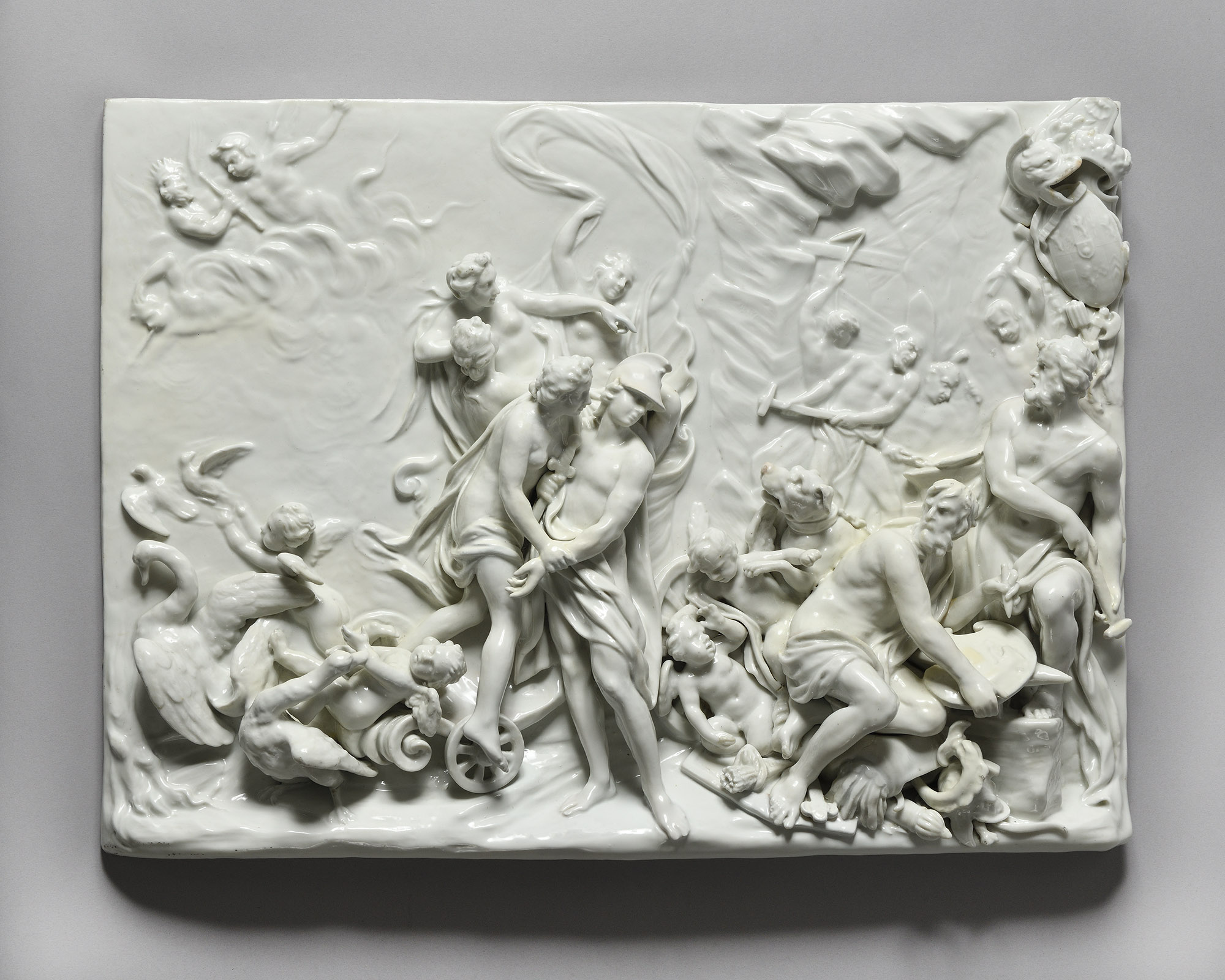
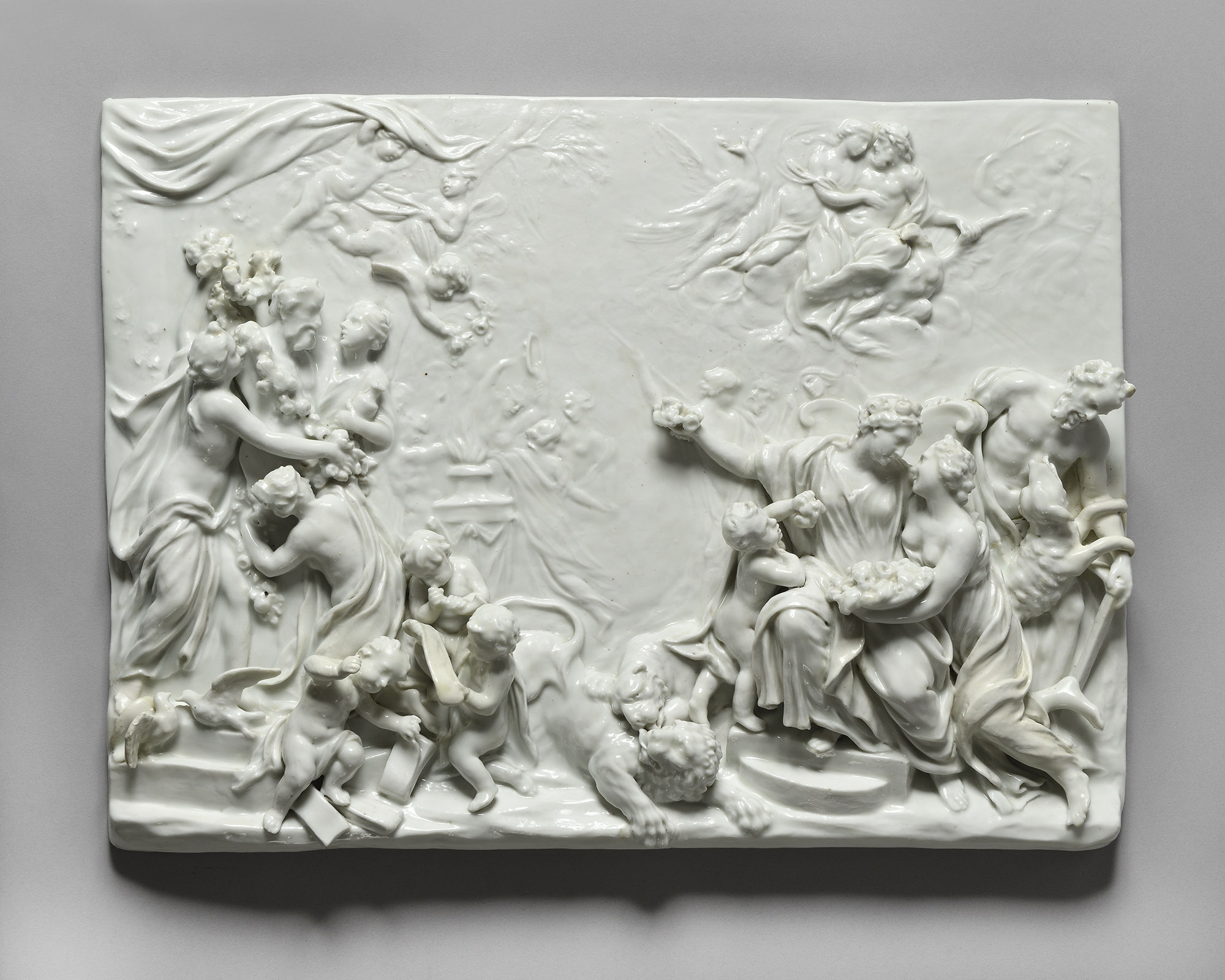
The spring relief depicts the theme of fertility and procreation. The goddess Flora, seated on a throne, appears on the right, symbolised by the wreath from which, according to Ovid, flowers fall whenever she shakes her head. On the left, three nymphs adorn a statue of Pan with flowers, whilst at the bottom, three cupids play and sing. Above the clouds, Jupiter embraces his wife Juno, and above the rainbow, Iris, messenger of the gods, kisses Zephyr, the gentle south-westerly wind. The other relief depicts winter through the same kind of mythological references: the work of Vulcan, the blacksmith who masters fire and thus defies winter, personified by Aeolus, who heralds the rigours of winter through the cold and violent winds from the north. The reference to the Palatine Prince’s patronage is clearly established by the coat of arms of the Palatinate Electorate, hung at the entrance to the forge: it features the Orders of Saint Hubert and the Golden Fleece, and, prominently displayed on the shield, the Imperial Orb.
Not far from there, Mars helps Venus – who has come to fetch weapons for her son Aeneas – to dismount from her chariot of seashells, driven by the Three Graces.
Italy, Late 18th century
Old restorations
H 40,5 cm L 56 cm
These allegorical works are therefore inspired by the series of bronze sculptures known as the Four Seasons, created between 1708 and 1711, which were subsequently presented by Ferdinand de’ Medici, Crown Prince of Tuscany, to his brother-in-law, Johann Wilhelm of Pfalz-Neuburg, Elector of Düsseldorf, and are now housed in the Bavarian National Museum in Munich.
The terracotta works, for their part, are still kept in the Grand Ducal Treasury at the Pitti Palace in Florence. These bronze reliefs are a typical example of the ‘sculptural paintings’ by Massimiliano Soldani Benzi (1656–1740), master engraver to Grand Duke Cosimo III de’ Medici, in which he combined literary motifs with classical examples.
Soldani had already submitted an initial version of the *Allegories of the Four Seasons* to Johann Adam Andreas I of Liechtenstein in 1694, but in the end, only a single relief was commissioned. A second version of the *Seasons* was created for Lord Burlington and is now divided between the Royal Collections at Windsor and the Spencer Museum of Art in Lawrence, Kansas.
Following the end of the Medici rule in Tuscany, Marquis Carlo Ginori (1701–1757) founded the Doccia porcelain factory near Florence in 1737. He recruited Giorgio delle Torri and J.K.W. Anreiter von Zirnfeld, who had both worked at the Paquier factory in Vienna, as well as the Florentine sculptor Gaspero Bruschi as chief modeller.
Porcelain was a new and fashionable material, and as Ginori held the secret to genuine Viennese hard-paste porcelain, this opened up sculptural possibilities for his factory that were beyond the reach of soft-paste porcelain manufacturers, as the latter was extremely unstable during firing. At the time, only Meissen and du Paquier also produced hard-paste porcelain in Europe.
Following Soldani Benzi’s death in 1740, Ginori purchased the moulds for his work from his pupil Lorenzo Maria Weber in 1743, and then from his son, Ferdinando, in 1744. Among these acquisitions were the moulds for the ‘Four Seasons’ plates.
The date of production of these plates remains uncertain. In 1765, Doccia introduced a new porcelain body, as well as a tin oxide glaze (for whiteness and opacity). It is thought that large reliefs of this type date from this period, rather than from an earlier one, because of their whiteness.
The manufactory also had models produced in the 19th century. These are distinguished by a thin porcelain frame around the edge, which is absent from all 18th-century versions, the Soldani Benzi moulds and the wax casts made from them.
A relief depicting autumn was sold by Christie’s in the 1920s and subsequently by Sotheby’s in London on 26 February 1963 (lot 9). Two other reliefs, one depicting Spring and the other Winter, are held at the Museo Nazionale di Palazzo Venezia in Rome.
A complete set of four reliefs was sold by Christie’s Geneva on 2 October 1969 (lot 91).
A relief depicting Winter was sold by Sotheby’s Florence on 22 October 1976 (lot 166) and one depicting Spring was sold by Sotheby’s London on 21 April 1998 (lot 35).
A set of four 19th-century plates (bearing the crowned ‘N’ mark) is held at the Museo di Doccia.

